
What Does Groundhog Removal Cost?
Honest, transparent pricing for humane groundhog trapping, burrow backfill, and permanent exclusion across South-Central Virginia. Every estimate is based on what we actually find — no guesswork, no upsells.
Call us: (434) 608-9636
- Inspection included
- Trap setup $225
- One return visit $60
- Inspection included
- Trap setup $225
- Three return visits $180
- Inspection included
- Trap setup $225
- Return visits $60–$120
- Burrow backfill $250–$600
- Inspection included
- Trap setup + returns $285+
- Underground barrier $600–$1,800
These are examples, not quotes. Every property is unique and your written estimate is based on actual burrow location, terrain, and scope.
| Inspection | Included in trap setup — no separate fee |
| Humane trapping | $225 setup + $60 per return visit |
| Burrow backfill | $250–$600 |
| Exclusion barriers | Typical $600–$1,800 — complex $1,800–$3,500+ |
Unlike our attic animal services, the groundhog inspection is included in the trap setup — no separate fee.
- Full property and structure perimeter inspection
- Identification of active burrows, den entrances, and tunnel networks
- Camera verification where applicable
- Recommendations for removal, backfill, or long-term exclusion
Why this matters: Groundhogs dig multiple burrows — some under sheds, others in open soil or under porches. A proper inspection determines which ones are active and what it will take to close them correctly. Guessing leads to missed tunnels and repeated damage.
- Setup package: $225 — up to 2 traps + 2 cellular monitoring cameras
- Placement at active burrow openings or travel paths
- Remote monitoring — we get instant notification when an animal is caught
- Return visits: $60 per trip for re-baiting, resetting, or animal removal
- No per-animal fee — two caught at once is still one trip charge
Why cameras? Our cellular trap cameras allow us to respond quickly when an animal is caught — no one has to physically check traps daily. This saves you money and ensures humane, prompt handling.
Once activity stops and all animals are confirmed gone, we close the burrow system:
- Verify all animals have been removed
- Backfill or collapse tunnels to prevent reuse
- Reinforce soil or install hardware cloth barrier where practical
- Photo documentation of finished work
This step prevents new groundhogs from reclaiming the same space. An empty burrow is an open invitation.
Typical homes or sheds: $600–$1,800 | Large decks, barns, or retaining walls: $1,800–$3,500+
- Underground wire barriers or L-shaped trench screens to prevent re-burrowing
- Shed and deck perimeters reinforced with galvanized mesh
- Old tunnels filled and soil stabilized to prevent sinkage
- Photo documentation of all finished work
Why people choose this: Groundhogs are territorial. Once one claims a spot, others are likely to return. A properly installed underground barrier prevents burrowing for years and protects foundations and structures from collapse.
3-year guarantee: Full exclusion and barrier installations come with our 3-year guarantee.
Only recommended when the situation calls for them. Our goal is to fix the root issue — not upsell extras.
Ready to get the groundhogs handled?
We'll assess the burrow situation, set up monitored traps, and give you a clear written plan — with photo proof every step of the way.
Schedule Service Contact UsGroundhog removal in South-Central Virginia starts at $225 for trap setup — the inspection is included at no extra charge. A single burrow under a shed typically totals around $285. Multiple burrows under a deck run around $405. Adding burrow backfill brings the total to $535–$945. Full exclusion with underground barriers runs $885–$2,085+. No per-animal fees.
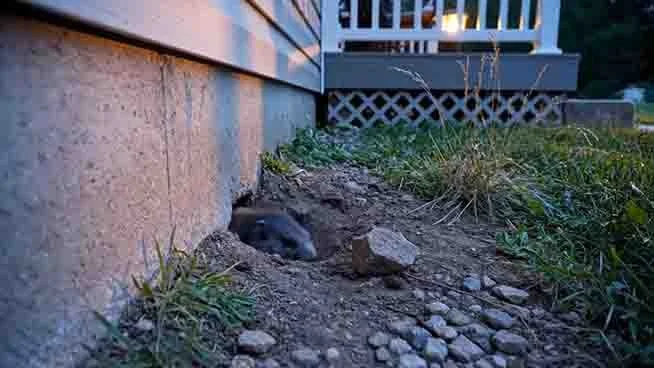
Look for large round holes 4–6 inches wide near your deck, shed, or foundation — often with a mound of loose soil at the entrance. You may also notice cracked concrete pads, settling around posts, garden damage, or soft sunken spots in the lawn. A single groundhog typically maintains 2–5 separate burrow entrances so there's usually more than one hole.
Yes — significantly. Groundhog burrows can reach 5 feet deep and 25 feet long, removing large volumes of soil from under concrete pads, footings, and shed foundations. This causes settling, cracking, and in severe cases structural failure. The longer a burrow system goes unaddressed, the more expensive the repair. Acting early is almost always cheaper.
Yes, if the burrow isn't filled and the area isn't properly excluded. Groundhogs are territorial and an empty burrow is an open invitation for a new one to move in. We always recommend backfilling after removal and offer permanent underground exclusion barriers with a 3-year guarantee for properties where ongoing protection matters.
Groundhogs are active in Virginia from February through October and hibernate during winter. They raise litters in spring (April–May), so if young are present, removal timing matters. Trapping is effective throughout the active season. The best time to install exclusion barriers is after removal — ideally in fall before they hibernate.
No. Our traps are paired with cellular monitoring cameras — we get notified immediately when an animal is caught and respond promptly. You don't have to check, re-bait, or interact with the traps at all. Return visits are only charged when we actually need to come back out.
Groundhogs are strong burrowers that can cause serious structural damage to lawns, concrete pads, foundations, and sheds. The sooner the problem is addressed, the better — for your property and your wallet.