
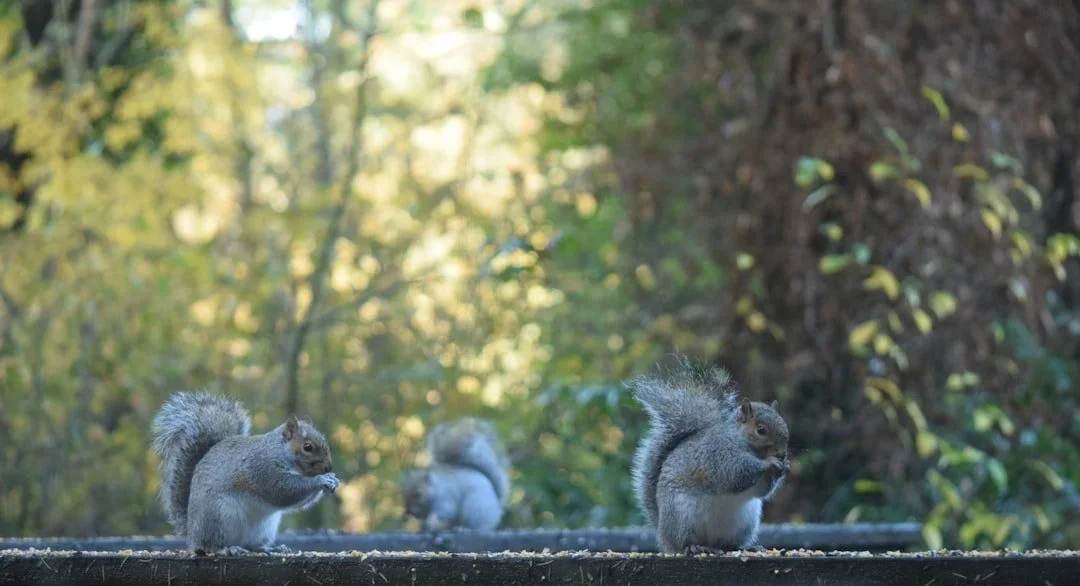
Gray Squirrel Removal in Roanoke, VA
Gray squirrels are the most common attic animal in the Roanoke region. Older neighborhoods with mature oaks and hickories give them easy roof access, and the aging soffits, fascia boards, and roof returns common throughout the area give them the entry points they need. Unlike raccoons, squirrels don't pry their way in — they chew. Their incisors grow continuously, and gnawing on wood and building materials is how they keep them worn down. A small gap becomes a clean hole in short order.
If you're hearing fast, light scampering at dawn or late afternoon — not at night — gray squirrels are the most likely explanation. Animal Dispatch handles gray squirrel removal throughout the Roanoke valley with a 3-year guarantee on exclusion work.
Gray squirrels are diurnal — active during the day, with peak activity at sunrise and late afternoon. They breed twice yearly: January through February producing spring litters, and June through July producing fall litters. Both breeding cycles drive squirrels to seek secure cavity den sites — and attics are ideal. Roanoke's older established neighborhoods provide exactly what squirrels need: mature trees for foraging and travel, aging rooflines with soft wood and developing gaps, and attic voids that mimic hollow trees in insulation and security. Squirrels apply their remarkable spatial memory to den sites — they remember successful attic entries and return year after year unless properly excluded.
We identify all entry points — not just the obvious one. Gray squirrels often use multiple gaps, and exclusion fails if any are missed. We look for chew marks, fresh wood shavings, grease rub points, and droppings.
One-way exclusion devices allow squirrels to exit but not re-enter. Timing matters — if young kits are present in the nest, removal must account for them.
All entry points — primary and secondary — are sealed with materials squirrels cannot chew through. This is the step that determines whether the problem is solved or just postponed.
Exclusion work is backed by a 3-year guarantee. Squirrels have excellent spatial memory for den sites — we seal the structure properly so they can't get back in.
- Trim tree branches that reach or overhang the roofline — squirrels use them as highways
- Repair soft or rotted soffit and fascia boards before squirrels find the wood
- Screen attic and gable vents with hardware cloth, not standard window screen
- Inspect roofline transitions and corners — squirrels test the same spots repeatedly
- Move bird feeders away from the house or switch to squirrel-resistant feeders
- Check the roofline twice yearly — spring and fall breeding cycles are when entries increase
Hearing squirrels in your Roanoke attic?
Squirrel problems escalate — chewed wiring, damaged insulation, and secondary entries develop over time. An inspection is the right first step.
Schedule an Inspection — $75 Contact Us